From the Ideal City to Operanda
The ideas that inspire us and the company we want to build.
Operanda draws inspiration from people who imagined better places to live, connected knowledge across disciplines, questioned inherited authority, and built tools that expanded human capability.
Their work helps us think about the company we want to build: careful in its design, open to independent contributions, and willing to change its mind when the evidence calls for it.
We believe people should gain more capable help while retaining the freedom to choose whom they trust, what they share, and how they live.
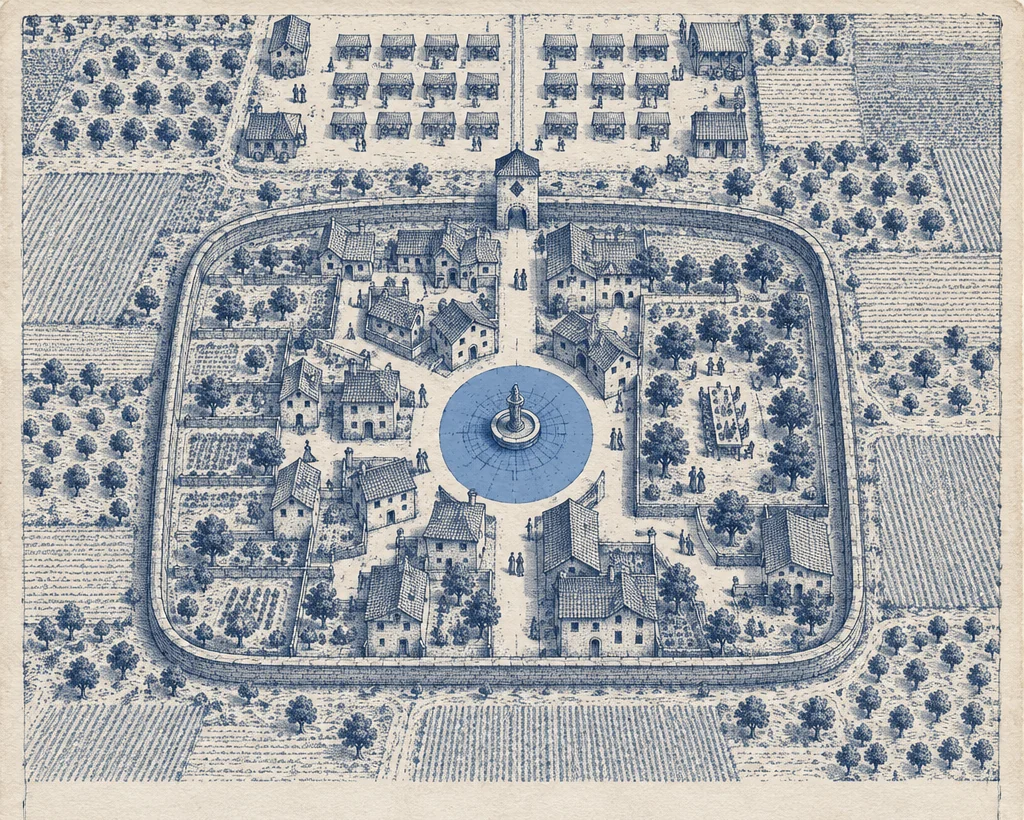
Circa 1480: imagining an ideal city.
In the Renaissance painting Città ideale, buildings and public spaces form a coherent vision of how a city could be. Geometry, proportion, and perspective give shape to an imagined ideal.
For us, its inspiration lies in the ambition to imagine better conditions for life, then give those possibilities form.
We believe building begins with imagining how life could be better. We consider what technology could make possible for people: greater understanding, more capable help, stronger relationships, and more freedom to pursue what matters to them.
We draw from the ideal city’s ambition while leaving room for different people to imagine different good lives. Shared foundations should help them pursue those lives on their own terms.
Circa 1750: connecting knowledge and questioning claims.
Scientific inquiry and the circulation of knowledge were changing how ideas could be examined. The Royal Society’s motto, adopted in 1662, expressed a commitment to testing statements through experiment.
In 1750, Diderot published the prospectus for the Encyclopédie. Its first volume followed in 1751. The project brought sciences, arts, and practical trades into a common reference, connecting expertise dispersed among different practitioners. In design, the emerging Neoclassical movement drew on the art and architecture of ancient Greece and Rome.
We believe knowledge grows more useful when it can be connected, questioned, and put to work. Useful expertise should be accessible, explanations understandable, and claims open to examination. Good evidence should be able to change our minds.
Circa 1780: consent and authority.
The American Revolution brought arguments about rights, representation, and legitimate government into institutional practice. The Declaration of Independence in 1776 grounded government’s legitimate powers in the consent of the governed. Around 1780, the outcome of that experiment remained uncertain.
Its language of equality coexisted with profound exclusions. Many did not receive the equality those words appeared to promise. That gap became part of the continuing struggle over their meaning.
We believe people should have meaningful control over decisions that affect their lives. Building systems that act for someone carries a responsibility to make authority explicit, limited, and accountable. Consent should be understandable, and people should be able to withdraw permission for future access. Respect for agency has to be expressed in how a system operates.
The late eighteenth and nineteenth centuries: making independent capabilities work together.
Industrialization brought machines, skilled workers, energy, and capital into new systems of production. Britain’s transformation accelerated between roughly 1760 and 1830.
As production and communication reached across greater distances, compatibility required shared agreements. The International Telegraph Convention of 1865 established common arrangements for international messaging, including technical rules and tariffs. Separate national networks could offer a more coherent service by agreeing on how to work together.
We believe independent expertise can flourish through cooperation. Shared foundations can help people and organizations contribute what they do well, learn from one another, and reach those who need their work. Greater collective capability carries a responsibility for how participants are treated and how benefits are shared.
The 1960s through the 1980s: making computation personal.
In his 1962 report, Augmenting Human Intellect, Douglas Engelbart described an approach to improving human intellectual effectiveness through tools, language, methods, and training. He considered the whole relationship between a person and their means of working.
Personal computers subsequently brought substantial computing capability into workplaces and homes. The IBM PC’s introduction in 1981 was one landmark in that expansion.
We believe technology should expand human capability. We care about what a person becomes able to understand, decide, and accomplish. The surrounding experience matters: the language we use, the methods we support, the information available, and the person’s ability to direct what happens.
1989–1993: connecting information through an open web.
Tim Berners-Lee developed the World Wide Web at CERN in 1989 to support information sharing. CERN released its web software into the public domain in 1993, helping enable its wider adoption. Common conventions allowed independently operated systems to participate.
We believe shared foundations should enable independent participation and choice. The web’s capacity to connect people and services across organizational boundaries inspires us. At Operanda, we want common ways for agents to work together while their builders maintain their own services and relationships. People should have room to build, contribute, and choose.
The 2000s and 2010s: digital lives spread across services.
People came to manage more of their lives through online accounts and applications. Preferences, correspondence, plans, purchases, and records accumulated across those services.
An assistant’s understanding of a person can remain fragmented. Changing assistants can mean rebuilding useful context.
We believe the understanding someone builds over time should remain useful as their tools change. Preferences, plans, and records can help people feel known and supported. That continuity should remain under their control, including when they choose another compatible agent.
The 2020s: moving from information to action.
Language models began to be combined with tools and interactive environments. Research such as ReAct explored systems that could plan, take actions, and use external information to adjust their approach.
That shift also demands better ways to assess results. Benchmarks such as OSWorld evaluate whether agents complete tasks in real computer environments, including work spanning applications. The resulting state of the task provides evidence of success.
We believe trust should be earned through responsible action. The more responsibility people entrust to a system, the more care it should take with context, permission, and evidence. We should acknowledge uncertainty, examine results, and correct mistakes.
Today: the company we want to build.
These inspirations shape how we think about our responsibilities at Operanda.
We are building a private, portable Vault for the information a person chooses to keep, and a way for their personal agent to bring in independent specialists when they can help. Each job uses the relevant, permitted context. We want accumulated understanding to keep serving the person as their agents and needs change, with clear permissions and evidence of what has been done.
Our company should embody the same qualities we seek in our work: care in design, curiosity in learning, rigor in judgment, respect for agency, and openness to independent contributions. Those qualities should be visible in our products, in how we work together, in how we treat the people who rely on us, and in how we respond when we fall short.
We return to the ambition of the ideal city: imagining how life could be better and helping give that vision form.
The future is uncertain, and the choices we make now will help shape it. We can help make this a moment people look back on for the possibilities it opened to everyone: greater understanding, more capable help, and more freedom to pursue their own idea of a good life.
This is the world we believe in and the one we’re going to make a reality.